
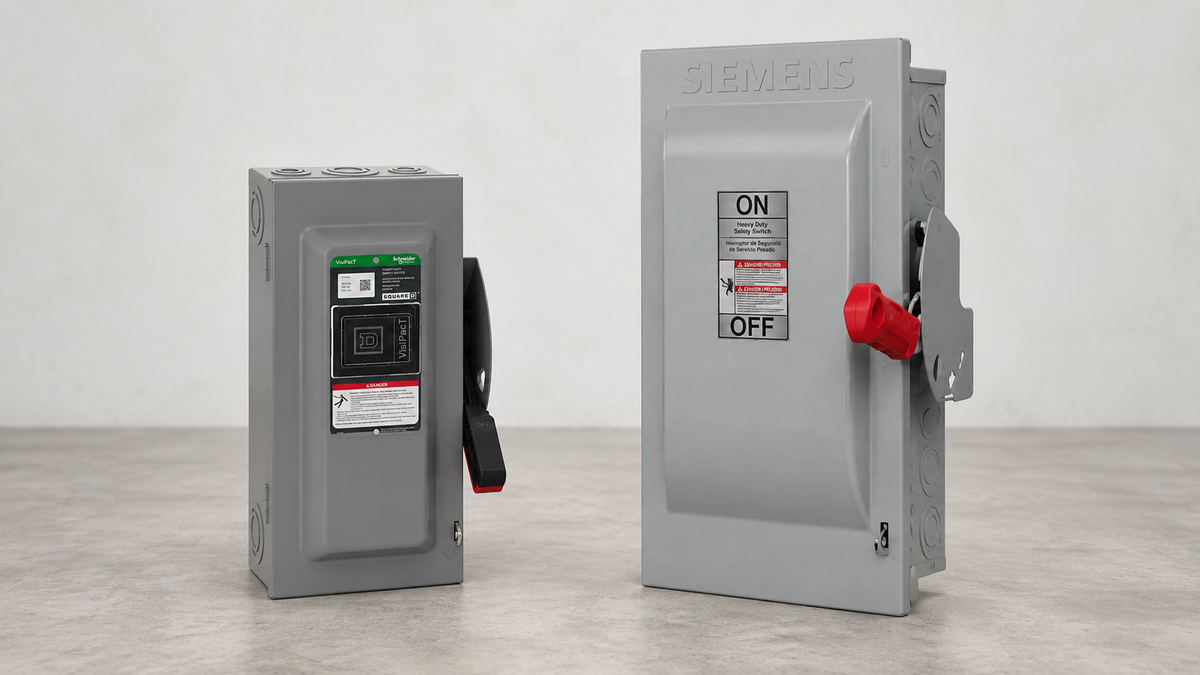
A safety switch provides a visible means of disconnecting power for equipment, branch circuits, and service applications. General-duty and heavy-duty switches can look similar from the outside, but they are intended for different voltage levels, operating demands, environments, and applications.
This guide explains the practical differences and the information you should verify before ordering a replacement.
Quick comparison: general duty vs. heavy duty
| Selection factor | General duty | Heavy duty |
|---|---|---|
| Typical application | Residential and light-commercial loads such as lighting, appliances, and air-conditioning equipment | Commercial and industrial equipment, motors, machinery, and demanding power-isolation applications |
| Typical voltage range | Commonly used on lower-voltage systems; verify the exact catalog number | Commonly available for higher-voltage systems, including many 600V applications |
| Operating demand | Economical choice for less demanding switching service | Built for frequent operation and more demanding environments |
| Enclosures | Commonly NEMA 1 or 3R | Available in NEMA 1, 3R, 12, and stainless-steel 4/4X configurations |
| Common options | Fusible or non-fusible, depending on series | Fusible/non-fusible, higher ampere ratings, accessories, and specialized enclosures |
These are category-level differences, not a substitute for the nameplate. Manufacturer series vary. For example, Schneider Electric lists its Square D general-duty range for applications up to 240VAC, while its heavy-duty range extends to 600VAC/600VDC and higher maximum ampere ratings. Always confirm the exact switch’s ratings.
What is a general-duty safety switch?
General-duty safety switches are designed primarily for residential and light-commercial applications where economy and reliable disconnecting are the main requirements. Common uses include lighting circuits, appliances, air conditioners, pumps, and other loads within the switch’s marked ratings.
A general-duty switch may be the right choice when the system is 240V or below, the environment is relatively clean, and the equipment does not require the construction or ratings of a heavy-duty model.
Breakers Now stocks general-duty safety switches such as the Siemens GF221NA 30A, 240V switch. Browse the dedicated General Duty Safety Switches collection for Siemens and Square D options.
What is a heavy-duty safety switch?
Heavy-duty safety switches are intended for commercial and industrial power isolation. They are commonly selected for motors, production equipment, HVAC systems, pumps, and other loads where higher voltage, frequent operation, horsepower ratings, or a more robust enclosure may be required.
Breakers Now stocks Siemens and Square D heavy-duty switches across several configurations, including:
- Square D HU361RB — 30A, 600V, non-fusible, NEMA 3R
- Siemens HF361S — 30A, 600V, fusible, stainless-steel 4/4X
- Siemens HNF361R — 30A, 600V, non-fusible, NEMA 3R
Shop Heavy Duty Safety Switches.
Fusible vs. non-fusible
A fusible safety switch contains provisions for fuses, allowing the assembly to provide a disconnecting means and fuse-based overcurrent protection when properly selected. Confirm the required fuse class, fuse size, short-circuit rating, and whether rejection provisions or adapters are involved.
A non-fusible safety switch provides isolation but does not add fuse protection. The circuit must receive the required overcurrent protection elsewhere. Do not replace a fusible switch with a non-fusible model—or the reverse—without reviewing the complete system design.
Choosing the correct NEMA enclosure
- NEMA 1: Indoor locations with basic protection against contact and falling dirt.
- NEMA 3R: Outdoor use with protection against rain, sleet, and external ice formation.
- NEMA 12: Indoor industrial locations where circulating dust, dirt, dripping, and light splashing are concerns.
- NEMA 4/4X: Washdown and wet environments; 4X adds corrosion resistance. Confirm the enclosure material, often stainless steel or nonmetallic construction.
An enclosure rating is part of the switch’s listing. Do not assume that installing a different gasket or hub changes the complete assembly’s rating.
Safety-switch selection checklist
- Manufacturer and complete catalog number
- General-duty or heavy-duty series
- Fusible or non-fusible construction
- System voltage and AC/DC rating
- Ampere rating
- Number of poles and wires
- Horsepower and load-break requirements
- Available fault current and short-circuit rating
- NEMA enclosure type and material
- Neutral, ground, auxiliary-contact, and hub requirements
- Indoor, outdoor, washdown, dust, or corrosion exposure
Shop safety switches at Breakers Now
Breakers Now stocks general-duty, heavy-duty, fusible, and non-fusible safety switches from Siemens and Square D, including NEMA 1, 3R, 12, and stainless-steel 4/4X options.
Shop General Duty Safety Switches, browse Heavy Duty Safety Switches, or view the complete Safety Switches collection.
Send us the complete catalog number and photographs of the switch nameplate if you need help identifying a replacement.
Hard to find, easy to buy.
Safety note: Safety switches must be selected for the circuit, load, available fault current, environment, and intended disconnecting duty. Installation and service should be performed by qualified electrical personnel in accordance with manufacturer instructions and applicable codes.