
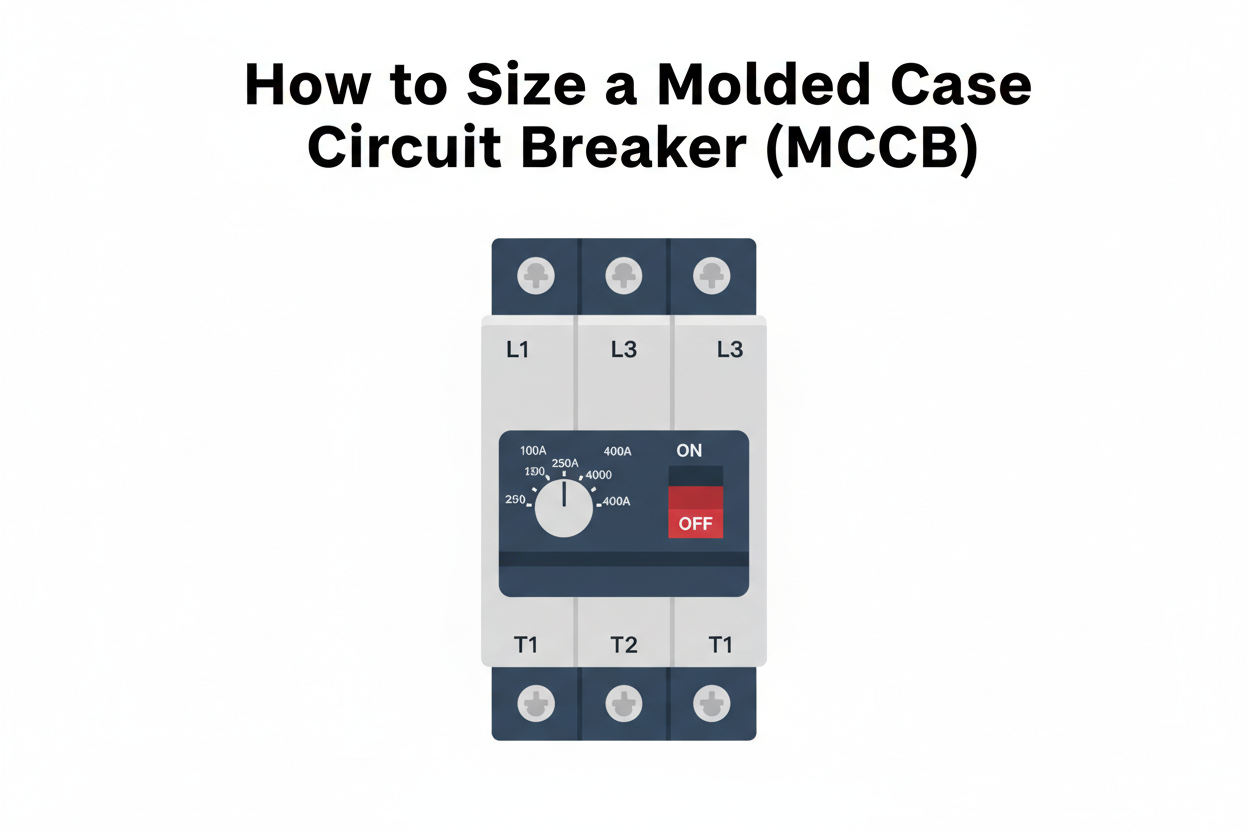
Molded case circuit breakers (MCCBs) are the workhorses of industrial and commercial electrical systems — but selecting the wrong size can lead to nuisance tripping, equipment damage, or worse, a protection gap. Here's how to size an MCCB correctly for your application.
Step 1: Determine Your Full Load Current (FLA)
What it is: The continuous current your load draws under normal operating conditions.
How to find it: Check the nameplate on your motor, panel, or equipment. For motors, use the NEC Table 430.250 values.
Your MCCB's continuous current rating should be at least 125% of the full load amperage for motor circuits (per NEC 430.52), or 100% of the load for non-motor circuits.
Step 2: Match the Voltage Rating
Purpose: Ensure the breaker's voltage rating meets or exceeds your system voltage.
Use Case: 240V, 480V, or 600V systems — each requires a breaker rated at or above that level.
Never use a breaker rated below your system voltage. A 240V-rated MCCB on a 480V system is a serious safety hazard. Always check both the AC voltage rating and whether the breaker is rated for single-phase or three-phase use.
Step 3: Verify the Interrupting Capacity (AIC/kAIC)
Purpose: The breaker must be able to safely interrupt the maximum available fault current at the point of installation.
Use Case: Industrial facilities, large commercial buildings, or any location close to a utility transformer.
Calculate or obtain the available short-circuit current (ASCC) from your utility or via an arc flash study. Your MCCB's interrupting rating (in kAIC) must equal or exceed this value. Standard MCCBs typically range from 18kAIC to 100kAIC.
Step 4: Select the Right Trip Class
Trip class determines how long a breaker will tolerate an overload before tripping — critical for motor starting:
- Class 10: Trips within 10 seconds at 600% FLA — for light-duty or energy-efficient motors.
- Class 20: Trips within 20 seconds — the most common for standard NEMA motors.
- Class 30: Trips within 30 seconds — for high-inertia loads like large fans, compressors, or pumps.
Step 5: Consider Adjustable Trip Settings
Many industrial MCCBs offer adjustable long-time, short-time, and instantaneous trip settings. This flexibility lets you fine-tune protection without swapping breakers — especially valuable in facilities where loads change over time.
Quick Sizing Reference
- Ampere Rating: ≥ 125% of FLA (motor circuits) or 100% (non-motor)
- Voltage Rating: ≥ System voltage (240V / 480V / 600V)
- Interrupting Capacity: ≥ Available fault current at installation point
- Trip Class: Match to motor type and starting characteristics
- Frame Size: Verify physical fit for your panel or enclosure
Need help selecting the right MCCB for your application? Our catalog includes molded case breakers from Eaton, Siemens, and Square D — with a range of frame sizes, trip ratings, and interrupting capacities ready to ship.