
NEMA Motor Starters: A Practical Guide to Choosing the Right Replacement
When a motor starter fails, finding a replacement can be more complicated than matching the horsepower on the motor nameplate. NEMA size matters, but so do the motor voltage, full-load current, coil voltage, overload protection, enclosure type and starter configuration.
This guide explains what a NEMA motor starter does, how NEMA starters differ from IEC starters and what information to collect before ordering a replacement.
What Is a NEMA Motor Starter?
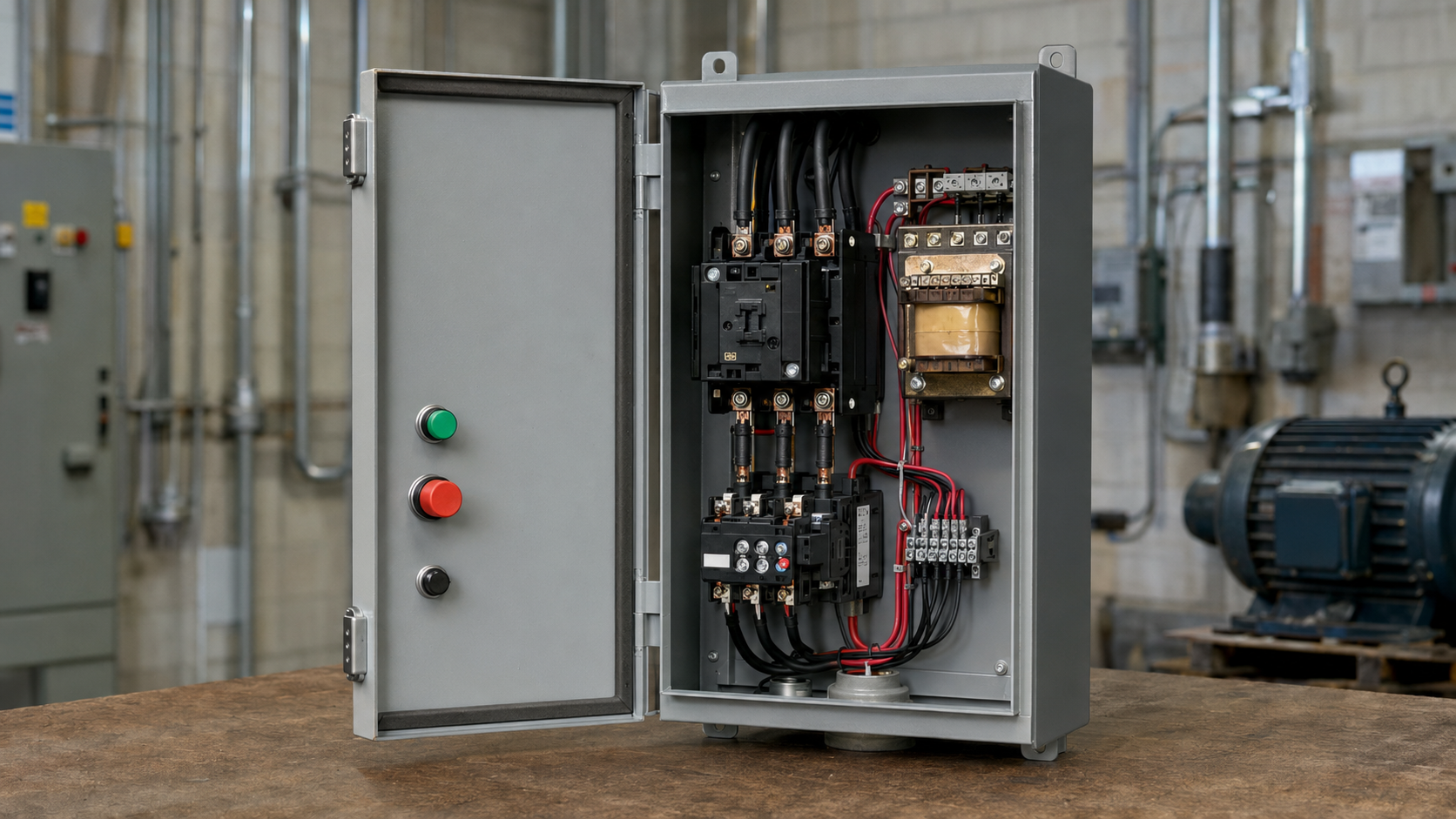
A NEMA motor starter is an electromechanical device used to start, stop and protect an electric motor. A typical magnetic starter combines:
- A contactor that opens and closes the motor power circuit
- An overload relay that helps protect the motor from sustained overcurrent
- A coil and control circuit that operate the contactor
- An optional enclosure, control transformer, pushbuttons, selector switch, pilot lights or auxiliary contacts
NEMA starters are commonly used with pumps, compressors, conveyors, fans, machine tools and other industrial equipment. Many are designed for full-voltage, across-the-line starting, although reversing, two-speed and other configurations are also available.
NEMA Starter vs. Contactor: What Is the Difference?
A contactor switches power to the motor. A motor starter adds overload protection to the contactor.
That distinction is important when replacing equipment. A contactor by itself may look similar to a starter, but it does not provide the same motor-overload protection. Short-circuit and ground-fault protection are normally supplied separately by properly selected fuses or a circuit breaker, unless the equipment is a listed combination starter.
NEMA vs. IEC Motor Starters
NEMA and IEC starters perform similar jobs, but they are selected differently.
NEMA starters use standardized sizes—commonly 00 through 9—with defined horsepower and current ratings. They are generally built with broad application ratings and are widely used in North American industrial facilities.
IEC starters are usually more compact and are selected more closely around the motor current and application duty. They can be an excellent choice in new equipment, but replacing a NEMA starter with an IEC device is not always a direct swap. Mounting, wiring, auxiliary contacts, overload behavior, enclosure space and short-circuit ratings must all be reviewed.
The Information You Need Before Ordering
Whenever possible, photograph the complete starter nameplate, motor nameplate, coil marking, overload relay and enclosure label. Then confirm the following details.
1. Manufacturer and Catalog Number
The existing catalog number is the best starting point. Record every letter and suffix. A suffix may identify the coil voltage, overload relay, enclosure, control transformer or factory-installed pilot devices.
If the label is damaged or incomplete, photos of the internal components and wiring can help identify the starter family and configuration.
2. NEMA Size
NEMA size establishes a starter's standardized motor horsepower and continuous-current capabilities. Do not assume that two starters with the same physical dimensions have the same rating.
The required size depends on the motor horsepower, motor voltage, phase and application. Always check the current manufacturer's selection table and the motor nameplate rather than relying on a generic size chart alone.
3. Motor Voltage, Phase and Horsepower
Confirm whether the motor is:
- Single-phase or three-phase
- 115, 200, 208, 230, 460, 575 volts or another voltage
- Rated for the connected horsepower
A dual-voltage motor nameplate may show two voltage and current values. Use the values that match how the motor is actually connected.
4. Motor Full-Load Amps
The motor's nameplate current is essential for selecting and setting the overload protection. Two motors with the same horsepower may have different nameplate currents.
Do not choose heater elements or set an electronic overload relay from horsepower alone. Follow the motor nameplate, applicable electrical code and the overload manufacturer's instructions.
5. Coil Voltage and Frequency
The contactor coil voltage is part of the control circuit and may be different from the motor voltage. For example, a 480-volt motor starter may use a 120-volt coil supplied by a control transformer.
Check the marking directly on the coil or the starter wiring diagram. Confirm whether the coil is AC or DC and, for an AC coil, the required frequency. Installing the wrong coil can prevent operation or damage the starter.
6. Overload Relay and Heater Elements
Older NEMA starters often use melting-alloy or bimetallic overload relays with replaceable heater elements. Newer starters may use adjustable electronic overload relays.
Identify:
- The overload relay catalog number
- The heater-element number, if used
- The motor nameplate amps
- The overload trip class or adjustable range, when applicable
- Manual or automatic reset
Heater elements are manufacturer- and relay-specific. A heater with a similar ampere marking is not automatically interchangeable.
7. Starter Configuration
Confirm the operating arrangement:
- Full-voltage non-reversing (FVNR): starts the motor in one direction
- Full-voltage reversing (FVR): uses forward and reverse contactors
- Two-speed: controls a compatible two-speed motor
- Manual starter: operated mechanically rather than by a magnetic coil
- Combination starter: includes a disconnecting and short-circuit protective device in the assembly
Also note the number of poles and any electrical or mechanical interlocks.
8. Enclosure Type
The enclosure must suit the installation environment. Common choices include:
- Type 1: general-purpose indoor locations
- Type 3R: outdoor locations, with protection from falling rain and sleet
- Type 4: indoor or outdoor locations requiring protection from windblown dust and water
- Type 4X: similar to Type 4 with added corrosion resistance
- Type 12: indoor industrial locations requiring protection from dust, dirt and dripping noncorrosive liquids
Hazardous locations require specifically listed equipment selected for the applicable class, division or zone and material group. A standard enclosed starter is not suitable merely because the box appears heavy-duty.
9. Operator and Accessory Requirements
Check for:
- Start/Stop pushbuttons
- Hand-Off-Auto or On-Off selector switches
- Run, Off or Trip pilot lights
- Auxiliary contacts
- Control transformer
- Control-circuit fuse protection
- Remote control devices
- Reset button or reset rod
These options can materially change the catalog number and internal wiring.
10. Short-Circuit Current Rating
Verify the equipment short-circuit current rating, or SCCR, and the upstream protective-device requirements. A replacement starter must be suitable for the available fault current and the complete installation—not simply the motor load.
A Quick Replacement Checklist
Before requesting a quote, collect:
- Existing starter manufacturer and complete catalog number
- Clear photos of the exterior, interior and all labels
- NEMA size
- Motor horsepower, voltage, phase and nameplate amps
- Coil voltage and AC/DC frequency
- Overload relay and heater-element numbers
- Non-reversing, reversing, two-speed, manual or combination configuration
- Enclosure type
- Pushbuttons, selector switches, pilot lights and auxiliary contacts
- Any required approvals or hazardous-location ratings
The more complete this information is, the faster a compatible replacement can be identified.
Common Motor Starter Selection Mistakes
Matching Only the Horsepower
Horsepower is only one part of starter selection. Voltage, phase, current, duty and manufacturer ratings also matter.
Confusing Motor Voltage With Coil Voltage
The power circuit and control circuit may operate at different voltages. Verify both independently.
Reusing the Wrong Heater Elements
Heater selection depends on the motor current, overload relay design and installation conditions. Use the exact manufacturer's table for the installed overload system.
Ignoring the Enclosure
An open starter or Type 1 enclosure is not an acceptable substitute where water, dust, corrosion or hazardous materials require a different enclosure or listing.
Assuming a Similar-Looking Starter Is Equivalent
Physical appearance does not confirm horsepower rating, coil voltage, overload range, SCCR, auxiliary-contact arrangement or approvals.
Need Help Identifying a NEMA Motor Starter?
Breakers Now can help identify hard-to-find NEMA motor starters, contactors, overload relays, coils, heater elements and related motor-control components.
Send us the complete catalog number and clear photos of the starter nameplate, motor nameplate and internal components. If the original unit is obsolete, we can help determine what information is needed to evaluate a replacement.
Hard to find, easy to buy.
Safety note: Motor-control equipment should be selected, installed and serviced by qualified personnel. Disconnect and verify all power sources before inspecting equipment. Final product selection must follow the motor and equipment nameplates, manufacturer instructions, applicable electrical codes and site-specific engineering requirements.
Shop Motor Starters
Browse our Motor Starters collection for in-stock open and enclosed starters, or shop Manual Motor Starters. If you need help matching a replacement, send us the complete starter and overload catalog numbers, coil voltage, NEMA size, and enclosure type.