
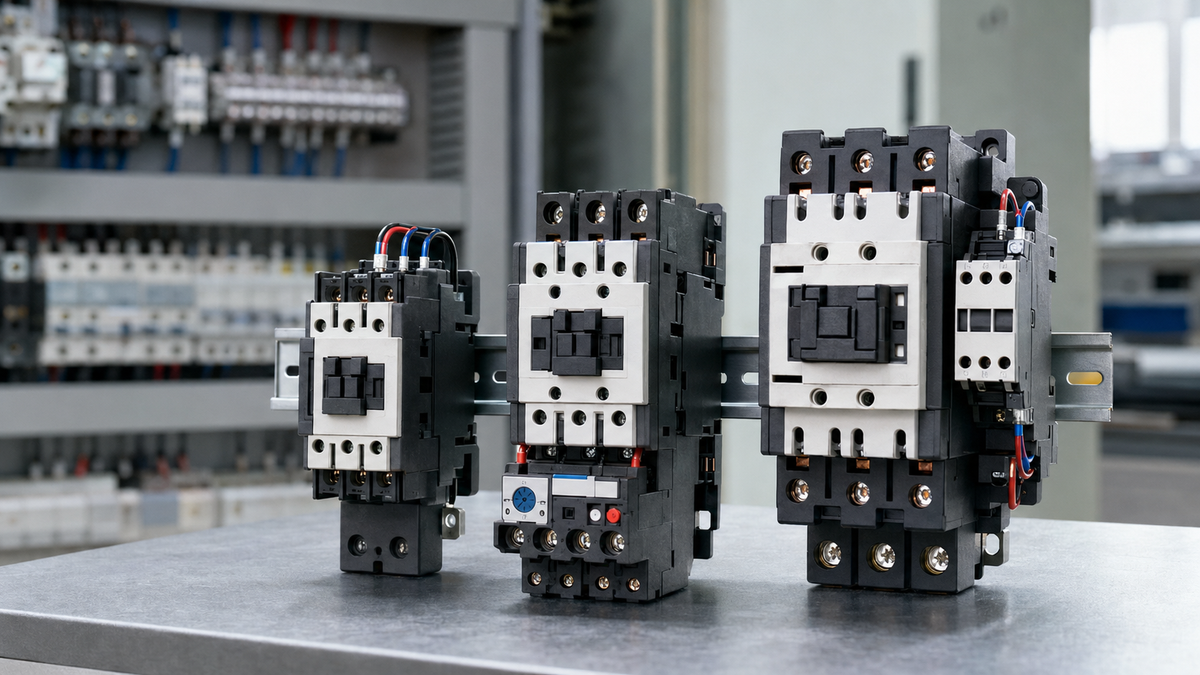
IEC Contactors: How to Choose the Right Replacement
IEC contactors are compact electrically operated switches used to control motors, heaters, lighting and other power loads. Although many contactors look alike, a safe replacement requires more than matching the physical size.
The load type, operational current, coil voltage, number of poles, auxiliary contacts and coordination with the overload relay all matter. This guide explains what to collect before ordering an IEC contactor.
What Does an IEC Contactor Do?
Applying the correct control voltage to the coil closes the contactor’s main contacts and energizes the load. Removing that voltage opens the contacts. A contactor provides switching, but it does not normally provide motor overload or branch-circuit short-circuit protection by itself.
In a motor starter, the contactor is typically paired with an overload relay. Proper fuses or a circuit breaker provide the required short-circuit and ground-fault protection.
IEC vs. NEMA Contactors
IEC contactors are normally selected closely around the application current and utilization category. Their compact, modular construction makes them common in machinery and control panels.
NEMA contactors use standardized NEMA sizes with broader horsepower ratings. Neither system is automatically better, and an IEC device is not necessarily a direct mechanical or electrical replacement for a NEMA device.
Information Needed to Select an IEC Contactor
1. Complete Catalog Number
Record every character on the existing contactor. Suffixes commonly identify coil voltage, terminal type, auxiliary-contact arrangement or special features.
2. Load and Utilization Category
The same contactor can have different current ratings for different loads.
- AC-1 generally covers non-inductive or slightly inductive loads such as resistance heating.
- AC-3 commonly covers starting squirrel-cage motors and switching them off while running.
- AC-4 covers more severe motor duty such as inching, plugging or jogging.
Do not use an AC-1 rating to size a motor application that requires an AC-3 or AC-4 rating.
3. Motor Voltage, Horsepower and Full-Load Current
For motor loads, collect the motor nameplate voltage, phase, horsepower and full-load amps. Use the manufacturer’s current selection table for the intended duty. Horsepower alone is not enough.
4. Coil Voltage and Type
The coil is part of the control circuit and may operate at a different voltage than the load. Verify:
- AC or DC coil
- Exact coil voltage or voltage range
- AC frequency
- Whether the coil includes suppression or electronic control
5. Poles and Contact Arrangement
Most three-phase motor contactors have three normally open power poles, but two-pole, four-pole and special arrangements are available. Confirm the required number and type.
6. Auxiliary Contacts
Auxiliary contacts provide holding circuits, interlocking, status indication and PLC feedback. Record the required normally open and normally closed contacts and whether they are built in, front-mounted or side-mounted.
7. Overload Relay Compatibility
If the contactor is part of a starter, identify the overload relay and its adjustment range. A replacement contactor must accept the correct overload relay or the complete starter combination must be re-evaluated.
8. Mounting and Terminals
Check DIN-rail or panel mounting, device width, terminal style, wire range and available enclosure space. Similar ampere ratings do not guarantee identical dimensions.
9. Reversing or Non-Reversing Operation
A reversing assembly uses two contactors plus mechanical and electrical interlocking. Do not replace one side without confirming the matching contactor, coil, auxiliary contacts and interlock components.
10. Short-Circuit Coordination
Review the contactor or starter’s ratings with the specified fuse or circuit breaker. The short-circuit current rating applies to the tested combination, not just the contactor by itself.
Replacement Checklist
- Manufacturer and complete catalog number
- Clear front, side and nameplate photos
- Load type and utilization category
- Motor voltage, phase, horsepower and nameplate amps
- Coil voltage, AC/DC and frequency
- Number of poles
- Required auxiliary contacts
- Overload relay catalog number and range
- Non-reversing or reversing configuration
- Mounting method and terminal type
- Required certifications and SCCR
Common Selection Mistakes
- Sizing a motor contactor from the AC-1 rating
- Confusing the motor voltage with the coil voltage
- Assuming the same amperage means the same physical footprint
- Forgetting auxiliary contacts or interlocks
- Treating a contactor as complete overload or short-circuit protection
- Mixing accessories from different contactor families
Need Help Finding an IEC Contactor?
Breakers Now can help identify IEC contactors, overload relays, coils, auxiliary contacts and replacement motor-control components. Send the complete catalog number, motor nameplate and clear photos of the existing assembly.
Hard to find, easy to buy.
Safety note: Electrical equipment should be selected, installed and serviced by qualified personnel. Final selection must follow the equipment nameplates, manufacturer instructions, applicable codes and site-specific engineering requirements.
Shop IEC Contactors
Browse our Contactors collection for in-stock IEC contactors from Schneider Electric, Eaton, Siemens, Allen-Bradley, and other major manufacturers. Use the full catalog number and coil voltage to narrow down the correct replacement.