
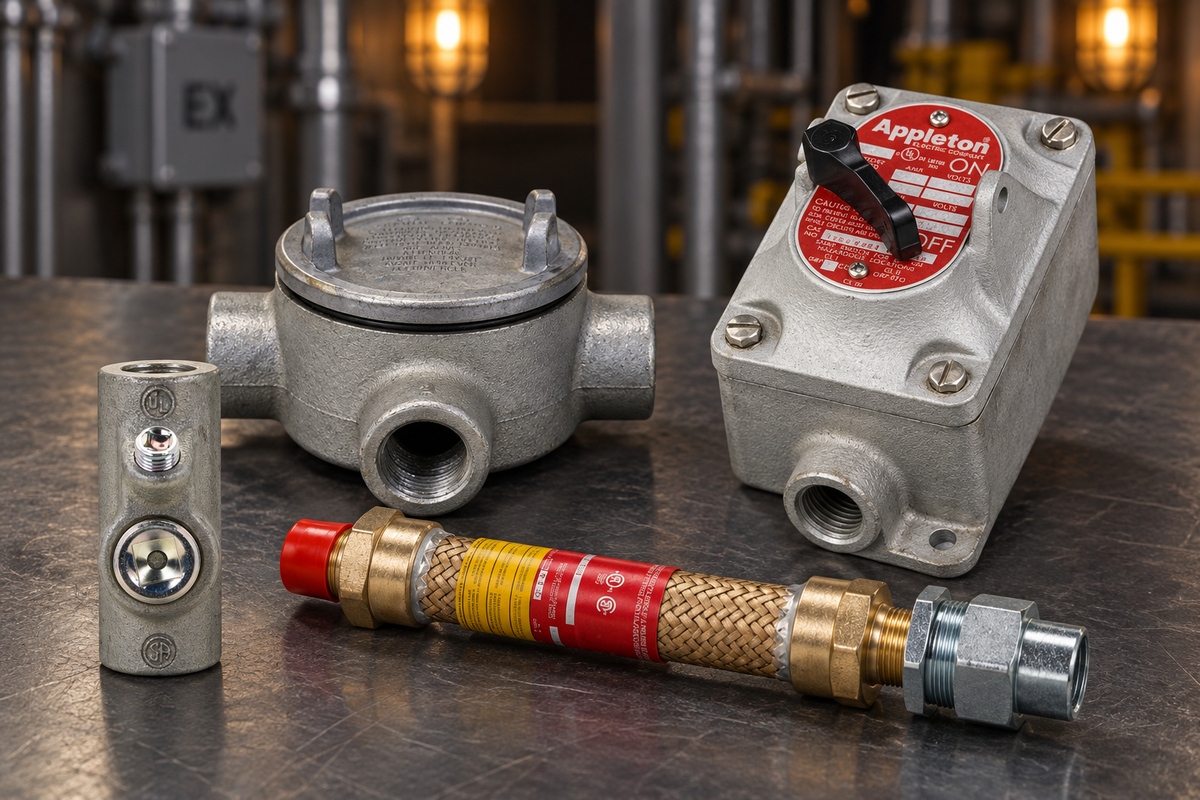
Industrial buyers sourcing equipment for classified locations cannot select fittings by conduit size alone. The complete installation must match the area classification, gas or dust group, temperature requirements, environmental exposure, conduit system, and the listing of the connected equipment. A fitting that looks interchangeable may not be an acceptable substitute.
Breakers Now supplies explosion-proof and hazardous-location fittings from established manufacturers including Eaton Crouse-Hinds and Appleton. This guide explains what purchasing teams, plant maintenance departments, electrical contractors, and MRO buyers should verify before placing an order.
What an industrial buyer needs before requesting a quote
Start with the approved drawings, hazardous-area classification documents, equipment schedule, or the exact manufacturer catalog number being replaced. A useful RFQ should include:
- Hazardous-location classification: Class and Division or Zone, plus the applicable gas, vapor, or dust group.
- Conduit information: Trade size, thread type, entry orientation, and whether the system is rigid metal conduit or another approved wiring method.
- Material and environment: Iron or copper-free aluminum, indoor or outdoor exposure, washdown conditions, corrosion concerns, and ambient temperature.
- Product function: Seal, conduit outlet box, union, flexible coupling, switch station, drain, breather, or enclosure.
- Approvals and ratings: Required UL, CSA, or other listing; enclosure rating; temperature code; and any project-specific approved manufacturer requirements.
- Exact manufacturer and catalog number: Especially important for replacements and projects with an approved-products list.
- Quantity and required date: Include shutdown dates or other schedule constraints so availability can be checked early.
Do not approve a substitution from appearance or trade size alone. The engineer of record, authority having jurisdiction, and applicable listing information should determine whether an alternate product is acceptable.
What “explosion-proof” means
Explosion-proof equipment is constructed to withstand an internal ignition of specified gases or vapors and limit the transmission of flame to the surrounding atmosphere. It does not make an entire facility immune from an explosion, and the term does not mean every product is approved for every hazardous location.
Classified-location installations are addressed by the National Electrical Code, including Articles 500, 501, 502, and related sections. Product markings and manufacturer documentation determine the specific applications for which a fitting is listed. Buyers should verify the current adopted code, project specifications, and local requirements before ordering.
Match the product to the application
Conduit sealing fittings
Sealing fittings help restrict the passage of gases, vapors, and flame through the conduit system. Their required location and installation depend on the classification, enclosure, conduit size, and applicable code rules. They must be installed with the approved sealing compound and fiber specified for the fitting.
Browse our seal-off fittings, including the Eaton Crouse-Hinds EYS21 3/4-inch sealing fitting. Confirm hub configuration, installation orientation, material, and required sealing compound before ordering.
Hazardous-location conduit outlet boxes
GUA-style outlet boxes provide access for pulling, splicing, and changing direction in threaded hazardous-location conduit systems. Buyers should confirm the hub arrangement—not just the number of hubs—because the catalog suffix identifies the physical configuration.
Shop hazardous-location outlet boxes or review the Eaton Crouse-Hinds GUAT26 3/4-inch T-style conduit outlet box. When replacing an installed box, verify hub positions, cover style, conduit size, material, and classification from the existing nameplate or approved drawings.
Flexible couplings
Flexible couplings are used where vibration, movement, or difficult alignment makes a rigid connection impractical. Common industrial applications include motors, pumps, compressors, and other vibrating equipment. Selection should account for trade size, connection style, overall length, bend requirements, environmental exposure, and hazardous-location listing.
The Eaton Crouse-Hinds ECLK218 is a 3/4-inch, 18-inch flexible coupling. Check the product page for current availability and confirm the end connections and required installation geometry before specifying it.
Explosion-proof switches and control stations
Local switches and control stations give operators a control point near industrial equipment while maintaining the required protection for the classified area. Buyers must verify the device function, poles, amperage, voltage, contact arrangement, hub configuration, and hazardous-location ratings.
Browse explosion-proof control stations and covers, including the Appleton EDSC175F1 20A factory-sealed tumbler switch. Factory-sealed designs can simplify certain installations, but their use must still match the project drawings and product listing.
Iron or aluminum?
Material is a functional specification, not just a price choice. Iron fittings are widely used in heavy industrial conduit systems. Copper-free aluminum can reduce weight and may be preferred where corrosion resistance or easier handling is important. Do not mix materials or substitute aluminum for iron—or the reverse—without confirming project requirements, compatibility, grounding and bonding provisions, environmental exposure, and the fitting’s listing.
Common purchasing mistakes
- Ordering by a shortened description instead of the complete manufacturer catalog number.
- Matching conduit size but overlooking hub configuration, gender, or thread type.
- Substituting a general weatherproof product for equipment listed for the classified location.
- Ignoring the gas or dust group, temperature code, or ambient-temperature limitation.
- Assuming a seal fitting includes the required compound, fiber, or installation accessories.
- Replacing an iron fitting with aluminum without engineering approval.
- Waiting until a plant shutdown to verify stock, lead time, and approved alternates.
Industrial RFQ checklist
For faster review, send the complete catalog number whenever possible. If it is unavailable, provide clear photos of the product and nameplate along with:
- Manufacturer and series
- Class, Division or Zone, and Group
- Conduit trade size and thread
- Material and finish
- Hub layout or connection configuration
- Voltage, amperage, poles, and contact function for control devices
- Required certifications
- Quantity, delivery location, and need-by date
For projects containing multiple components, buyers can source across our complete explosion-proof product collection, broader industrial fittings selection, or manufacturer-specific Crouse-Hinds and Appleton collections.
Always use qualified personnel and follow the approved drawings, manufacturer instructions, applicable electrical code, and authority-having-jurisdiction requirements. Product information on this page is a purchasing guide and is not a substitute for engineering review.