
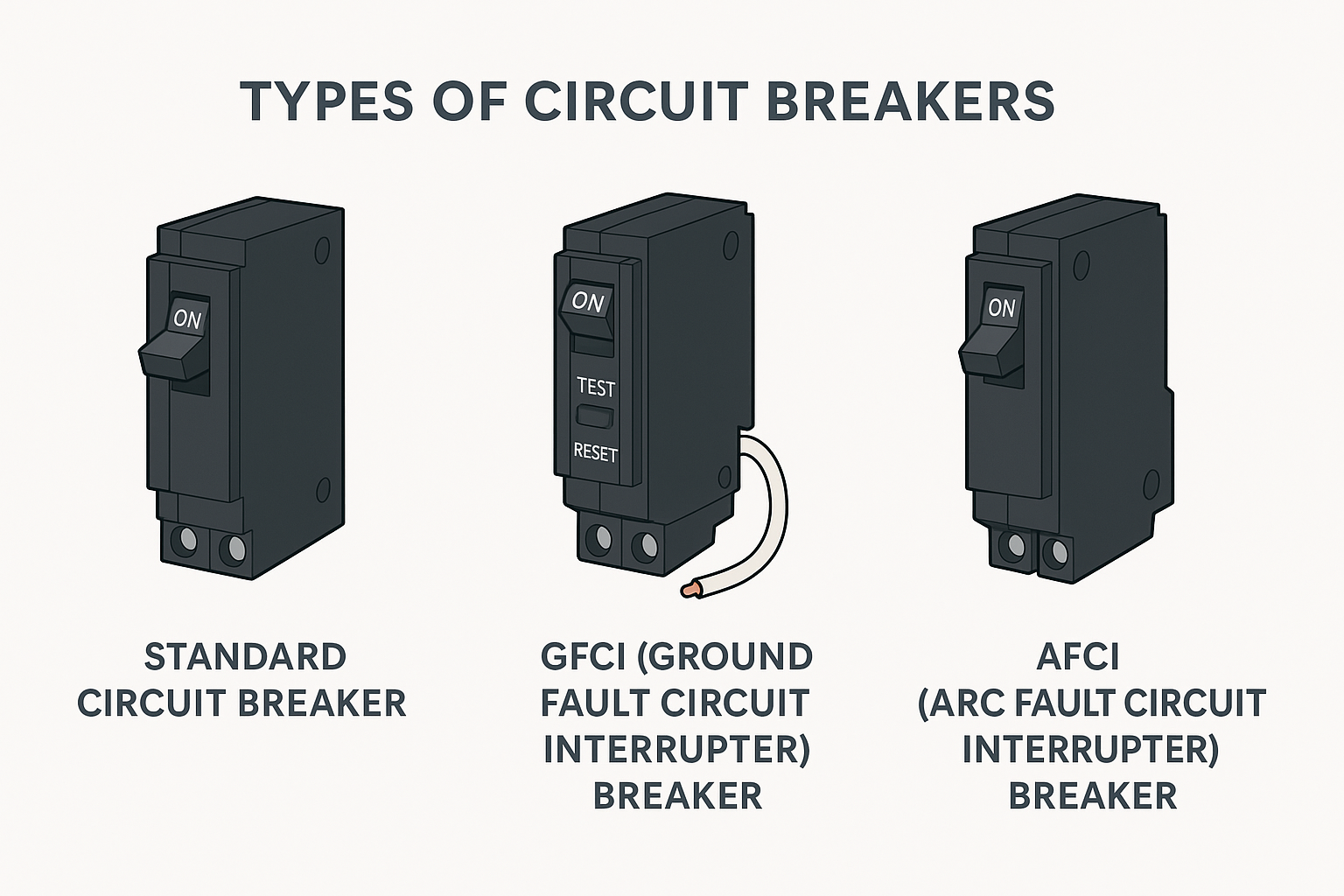
When it comes to keeping your home or facility safe from electrical hazards, circuit breakers are your first line of defense. But not all breakers are the same — and knowing the difference can help you choose the right protection for your system. Let's break down the three main types of circuit breakers and how they work.
1. Standard Circuit Breakers
Purpose: Overload and short circuit protection
Use Case: General-purpose residential and commercial circuits
Standard circuit breakers are the most commonly used type in residential panels. Their job is simple but essential: they monitor the flow of electricity and "trip" if the current exceeds the safe limit (measured in amps). This prevents overheating and potential damage to your wiring or appliances.
You'll find these protecting outlets, lighting circuits, and other everyday electrical systems.
2. GFCI (Ground Fault Circuit Interrupter) Breakers
Purpose: Protect against ground faults and electric shock
Use Case: Wet or damp locations (kitchens, bathrooms, outdoor outlets)
GFCI breakers are designed to quickly cut power when they detect a ground fault — that is, when electricity strays from its intended path and finds a shortcut to the ground, often through water or a person. These breakers are critical for preventing serious shocks and are required by code in many parts of a home.
If you're installing circuits in areas with potential water exposure, GFCI protection is a must.
3. AFCI (Arc Fault Circuit Interrupter) Breakers
Purpose: Protect against arc faults and electrical fires
Use Case: Bedrooms, living areas, and other finished spaces
Arc faults happen when loose or damaged wiring causes electricity to jump, or "arc," from one conductor to another. These arcs can generate high heat and spark fires — even without tripping a standard breaker. AFCI breakers are engineered to detect these specific patterns and stop them before they cause damage. Many modern building codes now require AFCI protection for various living areas.
Bonus: Dual-Function Breakers
Some advanced breakers combine GFCI and AFCI protection into one device — offering comprehensive safety from both ground faults and arc faults. These are especially useful in circuits where both types of hazards could be present.
Bottom Line:
- Use standard breakers for general overload protection.
- Use GFCI breakers to prevent shock in wet areas.
- Use AFCI breakers to guard against hidden wiring issues and electrical fires.
- Or choose a dual-function breaker to cover all your bases.
Not sure which type of breaker is right for your job? Our team is here to help you choose the right fit. Whether you're a contractor on a deadline or a facility manager looking to boost safety, we've got the breakers you need, shipped fast.